Mock sample for your project: Ipinfodb.com API
Integrate with "Ipinfodb.com API" from ipinfodb.com in no time with Mockoon's ready to use mock sample

Ipinfodb.com
ipinfodb.com
Version: 1.0.0
Speed up your application development by using "Ipinfodb.com API" ready-to-use mock sample. Mocking this API will allow you to start working in no time. No more accounts to create, API keys to provision, accesses to configure, unplanned downtime, just work.
It also improves your integration tests' quality and reliability by accounting for random failures, slow response time, etc.
Description
Other APIs in the same category

Quicksold REST API
Space Radiation API
amentum.space
Space has a hostile radiation environment that increases the risk of cancers in humans and malfunctions in spacecraft electronics. The types of space radiation of primary concern are:
Galactic Cosmic Rays from outside our solar system generated by
supernovae and other phenomena;
Solar Energetic Particles produced by the Sun during intense and
sporadic bursts of activity; and
Trapped Radiation: energetic particles confined by Earth's magnetic
field, usually comprising an inner belt of mostly high energy protons
and an outer belt dominated by lower energy electrons and plasma.
Understanding the space radiation environment for a particular mission profile is becoming increasingly important. Commercial off-the-shelf electronic components that aren't resilient to space radiation are now prevalent. Longer duration missions to cislunar space, Mars, and beyond are placing astronauts at greater risk of radiation exposure.
API requests must contain a key "API-Key" in the header (see code samples). Obtain a key from here.
Help us improve the quality of our web APIs by completing our 2 minute survey here.
Amentum Pty Ltd is not responsible nor liable for any loss or damage of any sort incurred as a result of using the API.
Copyright Amentum Pty Ltd 2021.
Galactic Cosmic Rays from outside our solar system generated by
supernovae and other phenomena;
Solar Energetic Particles produced by the Sun during intense and
sporadic bursts of activity; and
Trapped Radiation: energetic particles confined by Earth's magnetic
field, usually comprising an inner belt of mostly high energy protons
and an outer belt dominated by lower energy electrons and plasma.
Understanding the space radiation environment for a particular mission profile is becoming increasingly important. Commercial off-the-shelf electronic components that aren't resilient to space radiation are now prevalent. Longer duration missions to cislunar space, Mars, and beyond are placing astronauts at greater risk of radiation exposure.
API requests must contain a key "API-Key" in the header (see code samples). Obtain a key from here.
Help us improve the quality of our web APIs by completing our 2 minute survey here.
Amentum Pty Ltd is not responsible nor liable for any loss or damage of any sort incurred as a result of using the API.
Copyright Amentum Pty Ltd 2021.

IP geolocation API
Abstract IP geolocation API allows developers to retrieve the region, country and city behind any IP worldwide. The API covers the geolocation of IPv4 and IPv6 addresses in 180+ countries worldwide. Extra information can be retrieved like the currency, flag or language associated to an IP.

HERE Tracking
here.com
HERE Tracking is a cloud product designed to address location tracking problems for a wide range of Location IoT industry verticals.
HERE Tracking also includes end-user mobile and web applications that can be used to demonstrate the product.
HERE Tracking also includes end-user mobile and web applications that can be used to demonstrate the product.
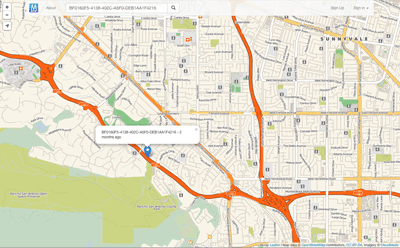
Miataru
The Miataru API is very simple and straight forward. Generally you're posting (HTTP POST) a JSON formatted request to a service method locations and you get back a JSON formatted answer. Please take into consideration that this has the request-for-comment status and that it can change while there's work done on client and server applications. Versioning therefore is done by prepending the version number - /v1/ for version 1 - to the method call.

Visual Crossing Weather API
Weather Forecast and Historical Weather Observation Data via an convenient, restful API.

Gisgraphy webservices
gisgraphy.com
Since 2006, Gisgraphy is a free, open source framework that offers the possibility to do geolocalisation and geocoding via Java APIs or REST webservices. Because geocoding is nothing without data, it provides an easy to use importer that will automatically download and import the necessary (free) data to your local database (OpenStreetMap, Geonames and Quattroshapes: more than 100 million entries). You can also add your own data with the Web interface or the importer connectors provided. Gisgraphy is production ready, and has been designed to be scalable(load balanced), performant and used in other languages than just java : results can be output in XML, JSON, PHP, Python, Ruby, YAML, GeoRSS, and Atom. One of the most popular GPS tracking System (OpenGTS) also includes a Gisgraphy client...Gisgraphy is a framework. As a result it's flexible and powerful enough to be used in a lot of different use cases. read more
if you use the premium servers, you can use the api key to test the webservices
if you use the premium servers, you can use the api key to test the webservices

GeoDB Cities API
mashape.com
The GeoDB API focuses on getting global city and region data. Easily obtain country, region, and city data for use
in your apps!
Filter cities by name prefix, country, location, time-zone, and even minimum population.
Sort cities by name, country code, elevation, and population - or any combination of these.
Get all country regions. Get all cities in a given region.
Display results in multiple languages. RESTful API adheres to industry best-practices, including
HATEOAS-style links to facilitate paging results.
Backed by cloud-based load-balanced infrastructure for resiliency and performance!
Data is periodically refreshed from GeoNames and WikiData.
Notes:
Since the database is periodically updated, this may very rarely result in certain cities
being marked deleted (e.g., duplicates removed). By default, endpoints returning city data will exclude
cities marked deleted. However, in the unlikely event that this occurs while your app is paging through a set
of affected results - and you care about the paged results suddenly changing underneath - specify
includeDeleted=SINCEYESTERDAY (or SINCELAST_WEEK if you're really paranoid!).
Useful Resources
SDKs
Angular,
Sample App
Java
JavaScript
Swagger Docs
Usage License
in your apps!
Filter cities by name prefix, country, location, time-zone, and even minimum population.
Sort cities by name, country code, elevation, and population - or any combination of these.
Get all country regions. Get all cities in a given region.
Display results in multiple languages. RESTful API adheres to industry best-practices, including
HATEOAS-style links to facilitate paging results.
Backed by cloud-based load-balanced infrastructure for resiliency and performance!
Data is periodically refreshed from GeoNames and WikiData.
Notes:
Since the database is periodically updated, this may very rarely result in certain cities
being marked deleted (e.g., duplicates removed). By default, endpoints returning city data will exclude
cities marked deleted. However, in the unlikely event that this occurs while your app is paging through a set
of affected results - and you care about the paged results suddenly changing underneath - specify
includeDeleted=SINCEYESTERDAY (or SINCELAST_WEEK if you're really paranoid!).
Useful Resources
SDKs
Angular,
Sample App
Java
JavaScript
Swagger Docs
Usage License
Checks API
NOTE: This is a preview of the API and it is not considered stable since refinements are still being made.
Introduction
Welcome to the Truora Check RESTful API reference. You may also want to check out our Validations API docs or our Signals API docs.
Truora Check API allows performing full background checks on people, vehicles and companies. There are three main types of background checks:
Personal background check: Verifies national IDs in multiple databases of public and legal entities in the LATAM region. For every national ID, returns information on: personal identity, criminal records, international background check, and professional background.
Vehicle background check: Verifies the vehicle documents and the owner identity in multiple databases of public and legal entities in the LATAM region. For every vehicle and owner type, returns information on: personal identity, driving records, criminal records, and vehicle information.
Company background check: Verifies the tax ID or a company name in multiple databases of public and legal entities in the LATAM region. For every company, returns the associated: business status, legal and criminal records, and media reports.
API Key V1 is live!
API key version 1 is now live. Users with version 0 API keys are not immediately required to upgrade to V1 but should plan to do so at their earliest convenience. The changes for integration with API keys v1 are as follows:
The field `user_authorized` is now required to perform person checks. This field indicates the API user has authorization to perform the check in compliance with data protection law.
The field `homonym_scores` is no longer included in our person check response as its results are already included in the body of the check and keeping them duplicated is generating unnecessary confusion.
API composition
Endpoints
Check endpoints: Provide an easy way to create and search for a background check. They also allow inserting groups of checks into reports. Each check contains scores, datasets and databases.
SDKs
If your favorite language was not on the next list, You can use our OpenAPI 3 spec to generate it using the Open API Generator.
To download the SDK click on the desired programming language:
C# .Net Core
Elixir
Go
Java
JavaScript
Objc
Php
Python
Ruby
You can see the full list of supported platforms here:
https://openapi-generator.tech/docs/generators
Introduction
Welcome to the Truora Check RESTful API reference. You may also want to check out our Validations API docs or our Signals API docs.
Truora Check API allows performing full background checks on people, vehicles and companies. There are three main types of background checks:
Personal background check: Verifies national IDs in multiple databases of public and legal entities in the LATAM region. For every national ID, returns information on: personal identity, criminal records, international background check, and professional background.
Vehicle background check: Verifies the vehicle documents and the owner identity in multiple databases of public and legal entities in the LATAM region. For every vehicle and owner type, returns information on: personal identity, driving records, criminal records, and vehicle information.
Company background check: Verifies the tax ID or a company name in multiple databases of public and legal entities in the LATAM region. For every company, returns the associated: business status, legal and criminal records, and media reports.
API Key V1 is live!
API key version 1 is now live. Users with version 0 API keys are not immediately required to upgrade to V1 but should plan to do so at their earliest convenience. The changes for integration with API keys v1 are as follows:
The field `user_authorized` is now required to perform person checks. This field indicates the API user has authorization to perform the check in compliance with data protection law.
The field `homonym_scores` is no longer included in our person check response as its results are already included in the body of the check and keeping them duplicated is generating unnecessary confusion.
API composition
Endpoints
Check endpoints: Provide an easy way to create and search for a background check. They also allow inserting groups of checks into reports. Each check contains scores, datasets and databases.
SDKs
If your favorite language was not on the next list, You can use our OpenAPI 3 spec to generate it using the Open API Generator.
To download the SDK click on the desired programming language:
C# .Net Core
Elixir
Go
Java
JavaScript
Objc
Php
Python
Ruby
You can see the full list of supported platforms here:
https://openapi-generator.tech/docs/generators
Flight Offers Search
amadeus.com
Before using this API, we recommend you read our Authorization Guide for more information on how to generate an access token.
Please also be aware that our test environment is based on a subset of the production, if you are not returning any results try with big cities/airports like LON (London) or NYC (New-York).
Please also be aware that our test environment is based on a subset of the production, if you are not returning any results try with big cities/airports like LON (London) or NYC (New-York).
World Time API
worldtimeapi.org
A simple API to get the current time based on a request with a timezone.

Search
Search API is a RESTful API that allows developers to run a single line fuzzy search for addresses and POIs. Search API returns the latitude/longitude of a specific address, cross street, geographic feature, or point of interest (POI).