Mock sample for your project: bng2latlong API
Integrate with "bng2latlong API" from getthedata.com in no time with Mockoon's ready to use mock sample

bng2latlong
Version: 1.0
Speed up your application development by using "bng2latlong API" ready-to-use mock sample. Mocking this API will allow you to start working in no time. No more accounts to create, API keys to provision, accesses to configure, unplanned downtime, just work.
It also improves your integration tests' quality and reliability by accounting for random failures, slow response time, etc.
Description
Convert an OSGB36 easting and northing (British National Grid) to WGS84 latitude and longitude.
Other APIs in the same category
Space Radiation API
amentum.space
Space has a hostile radiation environment that increases the risk of cancers in humans and malfunctions in spacecraft electronics. The types of space radiation of primary concern are:
Galactic Cosmic Rays from outside our solar system generated by
supernovae and other phenomena;
Solar Energetic Particles produced by the Sun during intense and
sporadic bursts of activity; and
Trapped Radiation: energetic particles confined by Earth's magnetic
field, usually comprising an inner belt of mostly high energy protons
and an outer belt dominated by lower energy electrons and plasma.
Understanding the space radiation environment for a particular mission profile is becoming increasingly important. Commercial off-the-shelf electronic components that aren't resilient to space radiation are now prevalent. Longer duration missions to cislunar space, Mars, and beyond are placing astronauts at greater risk of radiation exposure.
API requests must contain a key "API-Key" in the header (see code samples). Obtain a key from here.
Help us improve the quality of our web APIs by completing our 2 minute survey here.
Amentum Pty Ltd is not responsible nor liable for any loss or damage of any sort incurred as a result of using the API.
Copyright Amentum Pty Ltd 2021.
Galactic Cosmic Rays from outside our solar system generated by
supernovae and other phenomena;
Solar Energetic Particles produced by the Sun during intense and
sporadic bursts of activity; and
Trapped Radiation: energetic particles confined by Earth's magnetic
field, usually comprising an inner belt of mostly high energy protons
and an outer belt dominated by lower energy electrons and plasma.
Understanding the space radiation environment for a particular mission profile is becoming increasingly important. Commercial off-the-shelf electronic components that aren't resilient to space radiation are now prevalent. Longer duration missions to cislunar space, Mars, and beyond are placing astronauts at greater risk of radiation exposure.
API requests must contain a key "API-Key" in the header (see code samples). Obtain a key from here.
Help us improve the quality of our web APIs by completing our 2 minute survey here.
Amentum Pty Ltd is not responsible nor liable for any loss or damage of any sort incurred as a result of using the API.
Copyright Amentum Pty Ltd 2021.
bng2latlong
Convert an OSGB36 easting and northing (British National Grid) to WGS84 latitude and longitude.
Gravity API
amentum.space
The gravitational field of the earth is non-uniform. The geoid is the shape the
ocean surface would take if only gravity and the rotation of the Earth
were considered. The geoid is the surface that defines zero elevation.
The geoid height is the difference between an ideal reference ellipsoid and the geoid.
The gravity anomaly is the difference between the acceleration due to gravity on the Earth's surface and the value calculated assuming the reference ellipsoid.
The official Earth Gravitational Model EGM2008 was developed and released to the public by the National Geospatial-Intelligence Agency (NGA).
Our EGM2008 API provides on-demand access to the EGM2008 model, as implemented by the open-source GeographicLib Gravity library.
API requests must contain a key "API-Key" in the header (see code samples). Obtain a key from here.
Amentum Pty Ltd is not responsible nor liable for any loss or damage of any sort incurred as a result of using the API.
Copyright Amentum Pty Ltd 2021.
ocean surface would take if only gravity and the rotation of the Earth
were considered. The geoid is the surface that defines zero elevation.
The geoid height is the difference between an ideal reference ellipsoid and the geoid.
The gravity anomaly is the difference between the acceleration due to gravity on the Earth's surface and the value calculated assuming the reference ellipsoid.
The official Earth Gravitational Model EGM2008 was developed and released to the public by the National Geospatial-Intelligence Agency (NGA).
Our EGM2008 API provides on-demand access to the EGM2008 model, as implemented by the open-source GeographicLib Gravity library.
API requests must contain a key "API-Key" in the header (see code samples). Obtain a key from here.
Amentum Pty Ltd is not responsible nor liable for any loss or damage of any sort incurred as a result of using the API.
Copyright Amentum Pty Ltd 2021.

HERE Network Positioning API v2
here.com
Positioning API accepts requests with radio network measurements and replies with corresponding location estimate. For more details and examples, see Developer's Guide. Cellular measurements are given in terms defined in 3GPP and 3GGP2 specifications, see the corresponsing documentation at http://www.3gpp.org.
Breaking changes from v1:
JSON fields
altaccuracy, baselat, baselng, cellparams, pilotpower, pnoffset, powrx, rxlevel,
have been deprecated and replaced with
altAccuracy, baseLat, baseLng, cellParams, pilotPower, pnOffset, rss, rxLevel
respectively.
Dependent parameters combined as a subobject.
CDMA, GSM, WCDMA, TD-SCDMA and LTE local identification parameters for serving cell moved under localId property.
GSM neighbor global ID: lac and cid for neighbor cell moved under globalIdentity property.
Breaking changes from v1:
JSON fields
altaccuracy, baselat, baselng, cellparams, pilotpower, pnoffset, powrx, rxlevel,
have been deprecated and replaced with
altAccuracy, baseLat, baseLng, cellParams, pilotPower, pnOffset, rss, rxLevel
respectively.
Dependent parameters combined as a subobject.
CDMA, GSM, WCDMA, TD-SCDMA and LTE local identification parameters for serving cell moved under localId property.
GSM neighbor global ID: lac and cid for neighbor cell moved under globalIdentity property.

Maps
tomtom.com
The Maps API web services suite offers the following APIs:
Raster
The Maps Raster API renders map data that is divided into gridded sections called tiles. Tiles are square images (png or jpg format) in various sizes which are available at 19 different zoom levels, ranging from 0 to 20. For zoom level 0, the entire earth is displayed on one single tile, while at zoom level 20, the world is divided into 2 40 tiles.
Vector
Similar to Maps Raster API, the Maps Vector API serves data on different zoom level ranging from 0 to 22. For zoom level 0, the entire earth is displayed on one single tile, while at zoom level 22, the world is divided into 2 44 tiles.
The Maps Vector Service delivers geographic map data packaged in a vector representation of squared sections called vector tiles. Each tile includes pre-defined collections of map features (points, lines, road shapes, water polygons, building footprints, ect.) delivered in one of the specified vector formats. Format of the tile is formally described using protobuf schema.
Raster
The Maps Raster API renders map data that is divided into gridded sections called tiles. Tiles are square images (png or jpg format) in various sizes which are available at 19 different zoom levels, ranging from 0 to 20. For zoom level 0, the entire earth is displayed on one single tile, while at zoom level 20, the world is divided into 2 40 tiles.
Vector
Similar to Maps Raster API, the Maps Vector API serves data on different zoom level ranging from 0 to 22. For zoom level 0, the entire earth is displayed on one single tile, while at zoom level 22, the world is divided into 2 44 tiles.
The Maps Vector Service delivers geographic map data packaged in a vector representation of squared sections called vector tiles. Each tile includes pre-defined collections of map features (points, lines, road shapes, water polygons, building footprints, ect.) delivered in one of the specified vector formats. Format of the tile is formally described using protobuf schema.

Search
Search API is a RESTful API that allows developers to run a single line fuzzy search for addresses and POIs. Search API returns the latitude/longitude of a specific address, cross street, geographic feature, or point of interest (POI).

IP geolocation API
Abstract IP geolocation API allows developers to retrieve the region, country and city behind any IP worldwide. The API covers the geolocation of IPv4 and IPv6 addresses in 180+ countries worldwide. Extra information can be retrieved like the currency, flag or language associated to an IP.

LotaData
lotadata.com
Access the most exhaustive, accurate and up-to-date collection of global and hyper-local geocoded events and activities across a wide range of categories and genres

TrapStreet API
trapstreet.com
The TrapStreet API finds trap streets in Google Maps, Bing Maps and OpenStreetMap data.
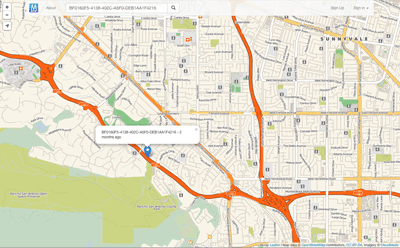
Miataru
The Miataru API is very simple and straight forward. Generally you're posting (HTTP POST) a JSON formatted request to a service method locations and you get back a JSON formatted answer. Please take into consideration that this has the request-for-comment status and that it can change while there's work done on client and server applications. Versioning therefore is done by prepending the version number - /v1/ for version 1 - to the method call.